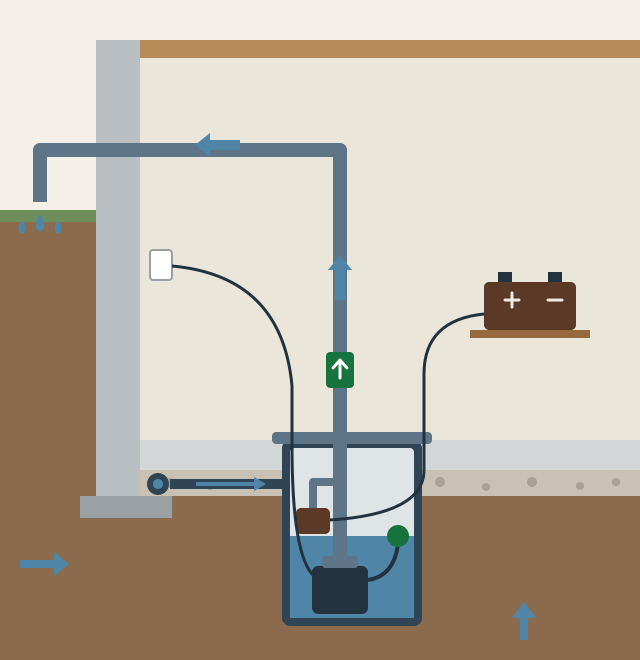
Where the pit goes
At the place water already collects. In a basement that is usually a corner where the floor dips or where an interior drain ends. In a crawl space it is the low end of the soil, under the liner if there is one. A pit set where it was easy to dig, not where the water is, will sit dry while the far wall stays wet.
Where the water may be sent
This is the part most often done badly. The pipe should end far enough from the house, on ground that falls away, so the water does not circle back to the foundation. It should not cross onto a neighbor's lot or pour over a sidewalk.
Inside Clarksville, remember what the street drains are. The city's stormwater page explains that storm sewers do not lead to a treatment plant. They empty into the Cumberland and Red River watersheds. Clean ground water from a sump is one thing. Wash water, a floor drain or anything oily must never share that pipe.
And if the yard has a sinkhole, do not let anyone aim the pipe at it. The county's sinkhole guidance says a change that sends more runoff into a sinkhole needs a state permit. There is more on sinkholes and yard water.
Why the battery backup is not an extra
The storms that fill a sump pit are the same storms that knock out electricity. A mains-only pump is then a pit full of water with a silent motor in it. A backup is a second pump, set a little higher, that runs from its own battery and starts when the water rises past the main pump's level.
Ask how long the battery is expected to run the pump, whether an alarm sounds when the backup starts, and how you test it. A battery ages whether it is used or not, so ask when it will need replacing.
Small parts that matter
- Check valve
- A one-way valve on the pipe. Without it, the water in the pipe falls back into the pit each time the pump stops, and the pump restarts to lift it again.
- Lid
- A sealed cover keeps damp air, soil gas and dropped objects out of the pit, and is quieter.
- Float switch
- The switch that starts the pump. It needs room to move. A float pinned against the pit wall is a common reason a working pump does nothing.
- Outlet
- The pump should have its own outlet close by. Ask whether new wiring is needed and who pulls the electrical permit.
Questions for the installer
- Where will the discharge pipe end, and what stops it freezing shut in January?
- Is the backup a separate pump or only a battery for the main one?
- If digging is needed for the pipe, who places the Tennessee 811 locate request?
- How do I test both pumps, and how often?
Sump pump questions
My pump runs every few minutes. Is that normal?
In a wet spell it can be. If it short-cycles all the time, look for a failed check valve, a float set too low or a discharge that drains back toward the house.
Do I need a pump if I am getting the crawl space encapsulated?
Only if water enters. A crawl space that is damp from humid air but never has liquid water in it can be sealed without one.