Why a vented crawl space turns wet in a Tennessee summer
Open foundation vents were once required because moving air was expected to carry moisture out. That works when the outdoor air is drier than the air under the house. From late spring into fall around Clarksville it is usually the other way round.
Under the floor it is shaded and cool. Humid air comes in, touches the ducts, the water pipes and the underside of the subfloor, and drops its moisture there. Bare soil adds more from below. The result is wood that stays damp, insulation that grows heavy and a smell that reaches the rooms above.
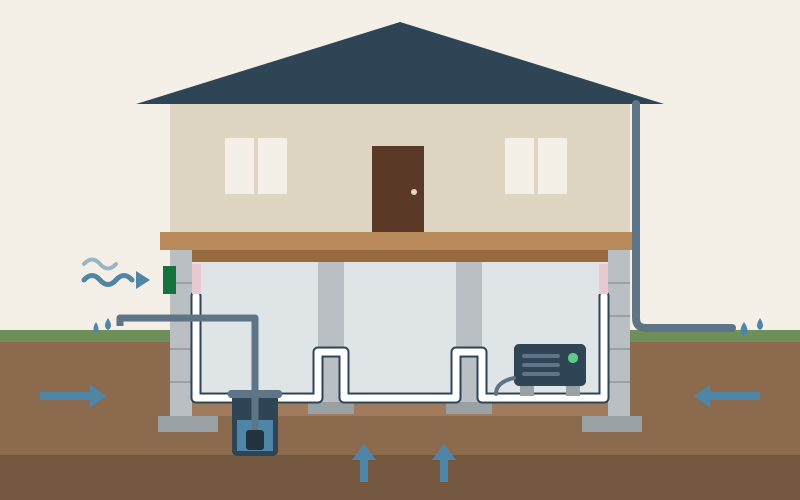
The parts of an encapsulated crawl space
- Liner
- A thick reinforced sheet over all the soil, run up the walls and around every pier, with the seams overlapped and taped. It stops ground moisture from evaporating into the space.
- Sealed openings
- Vents are blocked from inside and the access door is replaced or gasketed. Gaps where pipes and wires pass through the walls are closed.
- Wall insulation
- Rigid foam on the inside of the foundation walls often replaces the fiberglass between the joists, since the space is now inside the house's envelope.
- Drying
- A dehumidifier built for crawl spaces, or a small supply of conditioned air from the house system. Without one of these a sealed space can still be damp.
- Drainage
- Only where water actually comes in: a shallow trench along the wall and a sump basin under the liner. A dry crawl space does not need it.
What has to be put right before the liner goes down
A liner hides whatever is under and behind it, so the order matters.
- Standing water and the reason for it. Gutters, grading and any drain under the liner come first.
- Plumbing leaks and a dryer vent or condensate pipe that empties under the floor.
- Wet or moldy insulation, old plastic, wood scraps and debris. All of it comes out.
- Joists, beams or sill plates that have gone soft. They are repaired while they can still be reached.
- Visible growth on the wood. Ask what the company will do about it and what it will not.
The crawl space repair page covers those jobs. Many proposals bundle them with the encapsulation, so ask for them to be priced as separate items.
What the work is like at your house
Almost everything happens under the floor. Expect the access opening to be in use all day, material staged in the driveway or yard, and some noise if a drain or basin is being dug. Anything stored under the house has to come out first.
A dehumidifier or pump needs power, and a new outlet is electrical work with its own permit. Ask who arranges that and whether it is in the price.
Questions to put to the company
Write the answers down. They are how you compare two proposals that look alike at first glance.
- How thick is the liner, and how are the seams and the top edge fastened and sealed?
- Is a strip of bare wall left at the top so a termite inspector can still see the masonry?
- Where does the dehumidifier drain, and what happens if that drain blocks?
- Is there a gas furnace or water heater under the house, and how will it get the air it needs once the vents are closed?
- Which repairs are included, which are priced separately and which are not offered?
- What does the warranty cover, for how long and who stands behind it? Ask to see the document.
Encapsulation questions
Is plastic on the ground the same thing?
No. A loose vapor barrier on the soil slows evaporation from below, and that helps. It does nothing about humid air coming through the vents. Encapsulation closes the space and dries the air as well.
Does the work need a permit?
It depends on what is included. Montgomery County's Building and Codes office says a permit is needed to alter or repair a structure, and wiring for a pump or dehumidifier is electrical work. Ask the company which permits it will pull, and confirm with the city office at (931) 645-7426 or the county office at 931-648-5718.
Will the smell in the house go away?
If the smell comes from damp air and wet material under the floor, drying the space removes its source. Nobody can promise a result before seeing the crawl space, and other sources, such as a drain trap that has dried out, need their own fix.
What upkeep does it need afterwards?
Look in a couple of times a year. Check that the dehumidifier is running and draining, that the liner is still attached at the walls and that no water is sitting on top of it.